You don’t have to remove screens completely to reduce your child’s screen time. This guide covers five common screen-time problems and offers simple, practical solutions for everyday family life.
Table of Contents
“Ma, just one more video!“
You say no.
“Please, Ma….”
If this sounds familiar, you’re probably thinking about how to reduce screen time for kids in a way that actually lasts. Asking your child to turn off a device isn’t the first step in the screen-time battle. Here are a few common patterns for it:
- They want to watch YouTube when they come from school.
- They become bored while you prepare dinner.
- Expects a video to play during every meal.
These can become familiar patterns in family life. And if you try to change all of them at once, you may end up facing more arguments than progress.
You do not need to stop screens altogether. Understand which habits have made screens a default choice. Let’s look at five common screen-time challenges parents face and find practical ways to change them with alternatives that can work in everyday family life.
Also Read: How Much Screen Time Should Kids Have
Identify Screen Time Problems
Keep an eye on your child’s screen time to find common patterns.
- Maybe your child watches YouTube for an hour after school.
- Maybe your child asks for a phone whenever he is bored.
- Or your child refuses to eat without a video.
You do not need to fix all of these habits at the same time.
Pick one screen-time challenge that you find the most difficult to deal with. Let us discuss some of these:
Problem 1: YouTube After School
For some children, YouTube can become the automatic next step after coming home from school. They pick up a phone, tablet or turn on the TV to watch“just for a while.”
The problem is not one particular video. It is the automatic routine. Children even start expecting screen time as part of the transition from school to home.
My daughter did the same thing. She would finish one video and immediately look for the next one. Then another would start.
At first, I thought the solution was simply to limit her YouTube time. But I eventually realised that the problem wasn’t only how long she watched. It was the endless stream of videos available.
So I changed the routine.
Instead of YouTube Kids, I switched her screen time to scheduled television programmes (DTH). She had to wait for the next episode.
Solution: Manage YouTube Recommendations
- Choosing the videos before your child starts watching.
- Turning off autoplay where available.
- Deciding what your child will do after screen time ends.
Problem 2: Boredom = Screen time
Suppose your child is complaining that he/she is bored. You are in the middle of something. Giving them screen access may seem like the quickest solution.
But not the ultimate one!
Over time, your child may stop looking for something else to do because the solution is already familiar.
I’m bored → I get the screen.
Solution: Create an I’m bored activity box
Create a small I’m bored activity box. Include colouring sheets, crayons, puzzles, building blocks, storybooks, or simple craft supplies. Keep the box somewhere your child can reach without asking you to organise an activity.
You can also offer two choices instead of a long list: “Would you like to build something with blocks or do a drawing challenge?”
Give them room to think, explore, and come up with their own ideas.
Problem 3: Screens during meals
We sometimes allow screens during mealtime while feeding picky eaters. This is because screens keep a child seated and have their meals peacefully. It is also when we are tired or just not in a mood to speak continuously.
But have you ever thought:
When did the screen become part of the meal routine?
According to an article published in PubMed Central, screens during mealtime can lead to higher sugar consumption in kids.
Solution: Screen-free zones
Start with one screen-free meal each day. Put screens away during that meal. Talk with your child in this initial phase of switching off screens. With time, they will develop a habit of avoiding screens during mealtime.
Make the transition easier with conversation. Ask about a funny moment from school. Ask your child to describe something they enjoyed, or talk about what the family might do over the weekend.
If your child protests, stay calm and repeat without turning the meal into a lecture. Your child may refuse to eat, become upset or insist that they cannot finish the meal without a video. Be persistent and give them some time.
Having at least one meal together with my kid helped me to find a solution to screens during mealtime. We spent more quality time together. And to my surprise, one day my daughter deliberately turned off the TV as soon as she sensed that it was dinner time.
Problem 4: “One more” never seems to end
“Just one more round”. “One more episode”.
If your child plays online games, you have probably heard this more than once. You ask them to stop, but they want to finish the level.
Before you know it, the time you thought would be 20 minutes has stretched much longer. Stopping something enjoyable is difficult, especially when there is always another episode, level, or round waiting.
Solution: Set the rule before the game begins
You could say, “One more match and then we’re done,” rather than suddenly asking them to switch off while they are playing.
Have something ready that gives your child a similar sense of challenge or enjoyment.
- If they enjoy competition, try carrom, Ludo, or a quick family game.
- If they like building or problem-solving, offer blocks, LEGO, puzzles, or a building challenge.
- If they enjoy active games, suggest cricket, cycling, or outdoor play.
Also Read: Outdoor Play can Boost Learning
And yes, don’t make stopping feel like the end of all the fun.
Problem 5: Asks For Screens When You’re Busy
Parenting involves taking care of a dozen things on the go.
- You need to cook dinner.
- Have a scheduled work call.
- Manage laundry.
- Help another child with homework.
- Simply need some time for yourself.
And here’s your little one roaming around you with a twinkle in their eyes for a screen.
As a mom, sometimes you just need space. Parents can’t entertain kids every minute of the day, and sometimes a screen gives you the breathing space you genuinely need.
And it’s ok to let it go for a while!
The problem starts when screens become the automatic solution every time you are unavailable.
Solution: Keep Them Busy
First, identify the times when you regularly need uninterrupted time. Perhaps your busiest period can be when you prepare dinner or the hour after school when you need to finish work.
Keep a small selection of activities within your child’s reach. Drawing sheets and crayons, puzzles, building blocks or LEGO, storybooks, stickers and activity books, simple craft materials, and a small box of toys that you rotate every few days.
You can also give your child a little responsibility when appropriate. Kids can wash vegetables, arrange spoons, tear lettuce, or help set the table.
A simple task can sometimes be more engaging than asking, “Go and play.”
Here’s what I do:
My daughter loves to paint, dance and sing. I also keep some worksheets ready in advance for situations when I will be busy. I provide her with a few options, and then let her decide. Sometimes, she chooses to paint, sometimes to sing, sometimes to learn a few dance steps, and sometimes to do worksheets. There are days when she does not like any of my given options. I step back and and let her be.
Managing a child’s screen time isn’t always easy. Every child is unique, and so is the approach that works for them. Dear parents, you know your child the best. All you need to do is get that approach right.
Also, don’t force an activity on them. Your child might love to paint, but she might not want to do it now. Give them options to pick. It’s ok. They will figure it out themselves!
Also Read: Equipping Children for the Digital Era: Screen Smart Kids
Don’t Just Remove the Screen—Replace the Habit
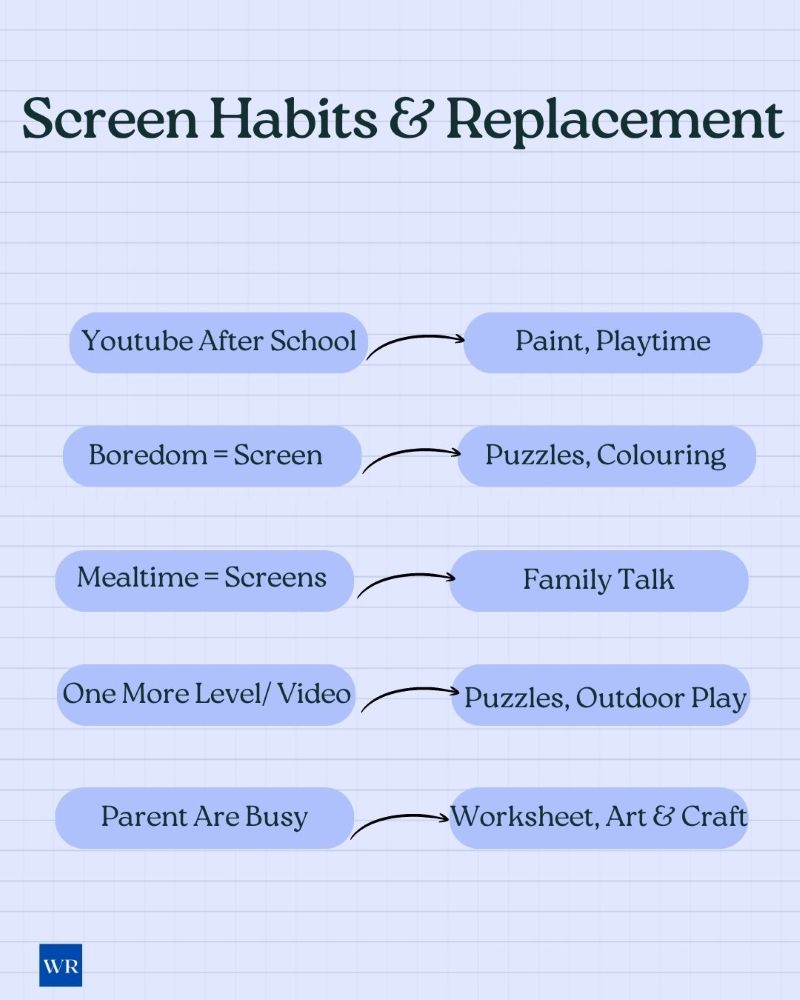
Taking away a device leaves a gap in your child’s routine. If you simply say, “Go play,” your child may not know what to do next. A practical replacement gives them a clear starting point.
Then choose an alternative that fits the situation.
Final Thoughts
Learning how to reduce screen time for kids doesn’t mean removing every device or filling every hour with activities. Start by noticing the habits that create the most difficulty. Is YouTube your pain point? Does boredom always lead to a phone? Has your child started expecting a screen during meals? Or do you reach for a device whenever you need to get something done?
Some days will go smoothly; others may bring protests or negotiation. Stay consistent where you can, adjust rules that do not fit your family, and keep the conversation open.
You do not need a perfect screen-free routine. You need a workable balance that lets screens share space with play, learning, family time, and everyday life.
FAQs
-
How to reduce screen time without daily tantrums?
Start by changing one screen-time habit at a time. Explain the rule before screen time begins. Spend time with them during this initial phase. Get their favourite activity ready during the transition period.
-
What can I do when my child gets bored without a screen?
Keep a few easy activities ready, such as colouring, puzzles, building blocks, storybooks, paper crafts, or a simple treasure hunt. Offer two choices instead of asking your child to think of something immediately. You can also give them time to work out what to do on their own. Children do not need a planned activity every minute of the day.
-
How do I stop my child from watching YouTube videos one after another?
Decide what your child can watch and how many videos they can watch before switching on YouTube. Turn off autoplay. Switch to DTH.
-
Should I reduce my child’s screen time gradually or all at once?
It is better to reduce screen time gradually. The right approach depends on your child, your family routine, and the reason for making the change.