
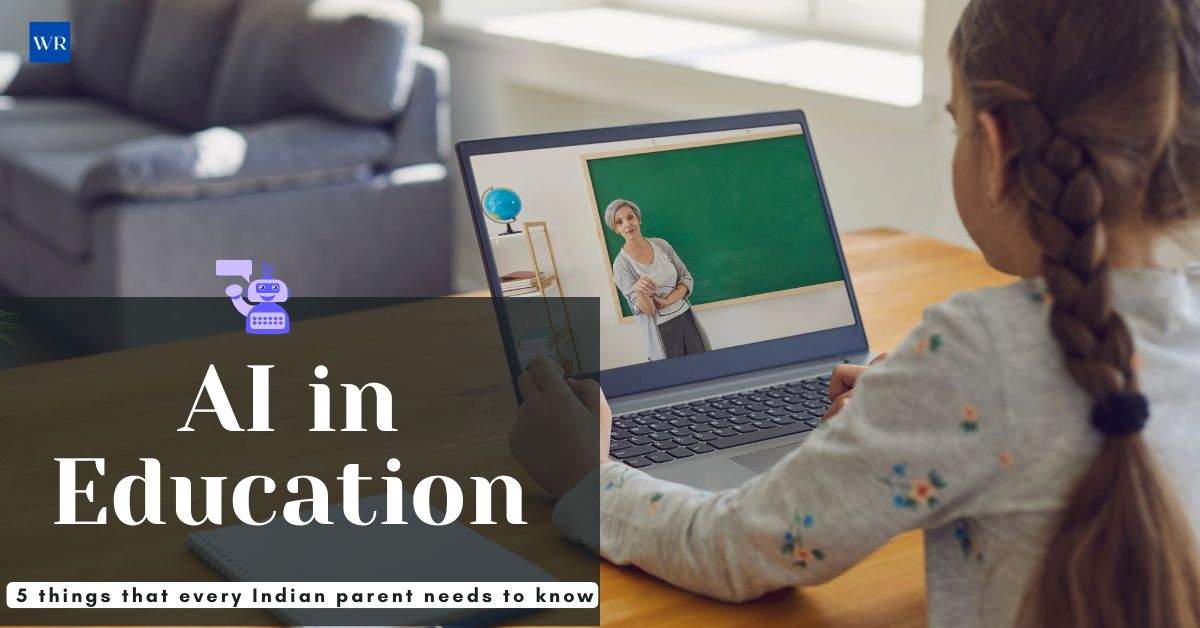
“ Mumma, we need to write an essay on AI in education for our summer holiday assignment. Can you help me with this?”
This is what my 12-year-old nephew said to his mother.
AI has been in the buzz since the launch of free AI tools (ChatGPT). Currently, numerous similar tools are available to assist us in every sector.
Schools have also adapted to this trend. For Indian parents, navigating the rapidly evolving use of AI in education is exciting and a little overwhelming.
AI in education is helping with personalised learning by adapting to a child’s unique pace and style. Let’s address the five key things that every parent needs to know about AI in Indian education.
Table of Contents
1. How AI in Education is Reshaping
The teacher-student ratio was on our checklist while selecting a school for our daughter. Like every parent, we wished her to grasp lessons and receive proper, on-time attention.
But these days, every class seems to have numerous sections with so many students in each.
It is also impossible for every teacher to give equal attention to each pupil during class hours.
AI is here to help you, dear parents.
With the help of AI in education, learning can be personalised for each child.
In an interview with the BBC, Sal Khan (founder of Khan Academy and Khanmigo), stated that students can remember things well if they connect them with their real-life experiences. Platforms like Khanmigo can make this possible with AI simulations. Here are a few
Also Read: How can kids take care of the elderly at home
Reasons why the application of AI in education can reshape the learning process.

- Adaptive Assessments: AI platforms can analyse responses in real-time, identifying strengths, weaknesses, and even preferred learning methods.
- Customised Content Delivery: Based on these assessments, the AI system then delivers specifically tailored content.
- Intelligent Tutoring Systems: Think of it as having a dedicated tutor available 24/7.
- Data-Driven Insights for Teachers: Teachers receive real-time dashboards that display each student’s progress, common misconceptions, and engagement levels.
Also Read: How to save Pocket Money as a Student?
2. The Benefits of AI in Indian Education
India has over 248 million students and has the potential to become a world leader in educational technology. There are numerous ways in which the benefits of AI in Indian education can be seen. Students can use AI to generate fresh ideas on a topic. Instead of waiting for the next day to get help on something they are stuck on, AI can help them within a few prompts.
However, AI should always be used as an assistant and not someone who is answering on behalf.
Benefits of AI in education
- Challenge: High Exam Pressure
- AI Solutions: Personalised Practice, early gap identification
- Challenge: Limitation in diverse classrooms
- AI Solutions: Adaptive content for varied learning styles
- Challenge: Limited Access to Quality Teachers
- AI Solutions: AI tutors, online platforms for remote learning
- Challenge: Lack of Individual Attention
- AI Solutions: Customised learning paths, real-time progress tracking
- Challenge: Rote Learning Tendency
- AI Solutions: Interactive lessons, emphasis on conceptual understanding
3. Tools with applications of AI in education
| Tools | Best for age | AI features | Description | Paid/Free |
|---|---|---|---|---|
| Khanmigo | 6+ (with supervision) | AI Tutors, assistants | Personalised learning. | Free for teachers. Paid for students/ parents. |
| Canva | 6+ | Magic Write, Magic Design, Magic Edit, Text-to-Image | Presentation, school projects | Free sign-up. Paid for more features. |
| Embibe | 10+ | Adaptive test preparation, personalised feedback | Exam prep, identifying weak areas | Free basic access; full features often paid) |
| BYJU’S | 4-18 | Adaptive learning paths | Interactive video lessons, personalised practice | Free trial. Most content is paid subscription) |
| Duolingo | 5+ | Adaptive learning algorithms, pronunciation feedback | Language learning vocabulary, grammar | Free and Paid |
| Storywizard.ai | 6-12 | AI-generated narratives and illustrations | Creative writing, storytelling, and imaginative play | Free and Paid |
| Grammarly | 13+ | Grammar, spelling checks, Plagiarism check and more | Digital writing assistant | Free and Paid |
4. What to ask Schools about applications of AI in education
We now know that the use of AI in education can be a more effective approach. Schools also encourage the use of AI to some extent for students. Some schools even have in-house AI tools/platforms for students and parents to participate.
But does this mean our role as parents is over? And there should be no further questioning?
Of course not!
Here are some queries that we can be concerned about and ask schools:
- What student data is collected by AI tools and stored?
- How is it stored?
- How are teachers being trained to use AI tools effectively?
- How will parents receive feedback on this?
- What dashboards or reports are available?
Dear parents, Don’t be overwhelmed by these questions. You can for sure ask the school authorities. If not all, at least a few of the most important ones!
5. How can we regulate the use of AI as a parent?

The integration of AI in education has come a long way. It takes a few clicks to find an answer or create something new.
Educational institutions have also approved the use of AI. We currently have platforms launching and successfully running these AI tools for students every day.
Responsible use ensures that the benefits of AI in education truly enhance learning without leading to over-reliance or exposure to risks. Here’s how parents can regulate the use of AI at home for kids.
Explain how, what, where, and when to use AI in education
- How to use AI: As an assistant and not something that can replace originality.
- What to use: Trusted platforms.
- Where to use: To brainstorm ideas or to get an analysis of the work done.
- When to use: When necessary/ get stuck.
Critical thinking and verification
Platforms like Khanmigo help students find the right answer by themselves. This makes students think about the steps involved and not only the answers. Hence, Khanmigo is distinct from other platforms like ChatGPT.
Teach children to question information provided by AI. AI models can sometimes provide inaccurate data. The information should be cross-referenced with textbooks, human teachers, or other reliable sources.
Kids should understand that AI lacks human empathy and common sense.
Prioritise Data Privacy and Security
Before allowing children to use an AI app, review its privacy policy. Understand what data is collected, how it’s stored, and whether it’s shared with third parties.
Ask them not to share personal details (address, phone numbers) with the chatbots. Keep an eye and be a co-learner
Explore the AI platform along with your child. Ask them about their experiences and any challenges.
Best Practices for AI in Education for Kids
Here are a few situations where kids can use AI and when not use it.
- Brainstorming Ideas: To start a project/topic.
- Explaining Complex Concepts: Asking AI to simplify difficult topics.
- Summarising Information: To quickly grasp the main points of long articles, videos, or research papers.
- Grammar & Style Checks: For proofreading.
- Learning New Languages: For personalised practice, pronunciation feedback, and vocabulary building.
- Practising Skills: Using adaptive platforms (like Embibe or Khanmigo) that identify weak areas and provide tailored practice exercises.
- Creative Exploration: Using AI for generating initial story ideas, character concepts, or visual inspirations
- Generating Study Aids: Creating flashcards, practice quizzes, or study guides from notes or textbooks
- Personalising Learning Pace: Utilising adaptive platforms that adjust to their individual speed and learning style
- Generate an entire assignment: This can lead to plagiarism.
- Copy-Pasting Answers: Using AI to provide direct answers to homework or test questions without understanding the underlying concepts.
- Cheating on Assessments: Using AI during exams, quizzes.
- Bypassing Critical Thinking: Relying solely on AI to solve problems
- Submitting Unverified Information: Accepting AI-generated facts, statistics, or sources without critically evaluating and verifying their accuracy.
- Violating Privacy: Inputting sensitive personal information (about themselves, friends, or family) into AI tools.
- Misattributing Work: Claiming AI-generated creative works as original
- Relying Exclusively on AI for Learning: Using AI to replace traditional learning methods like reading textbooks, engaging in classroom discussions.
Also Read: Best Brain Development Activities at Home for Kids
Conclusion
AI in education has come a long way. From helping to generate new concepts to reducing exam stress (quizzes, revision) to bridging learning gaps, the benefits of AI are unlimited. However, the use of AI in education by kids should be regulated by their guardians. Parents themselves need to know a few things before they can help kids with Artificial Intelligence. From understanding how AI is reshaping the world of education to its benefits. Tools like Khanmigo and Duolingo can help students level up their preparation. Regulating the use of AI for kids is also the need of the hour.
What are your child’s favourite AI tools? Answer in the comment box.
Also, give a thumbs up if you like this blog post.
FAQs
-
Is AI good for kids in school?
Yes, AI can be beneficial for kids in school if used efficiently. It can provide personalised learning, reduce learning gaps and help in practice.
-
Where can kids use AI tools?
Kids can use AI tools to learn a language, make a graphical presentation, practice storytelling, take quizzes, use it as a personal tutor and even learn coding.
-
Can AI replace teachers?
Of course not! AI can never replace teachers or any other human. AI tools lack human empathy and common sense. Hence, they can produce errors.




Leave a Reply