
Family is not an important thing; it’s everything.
– Michael J. Fox
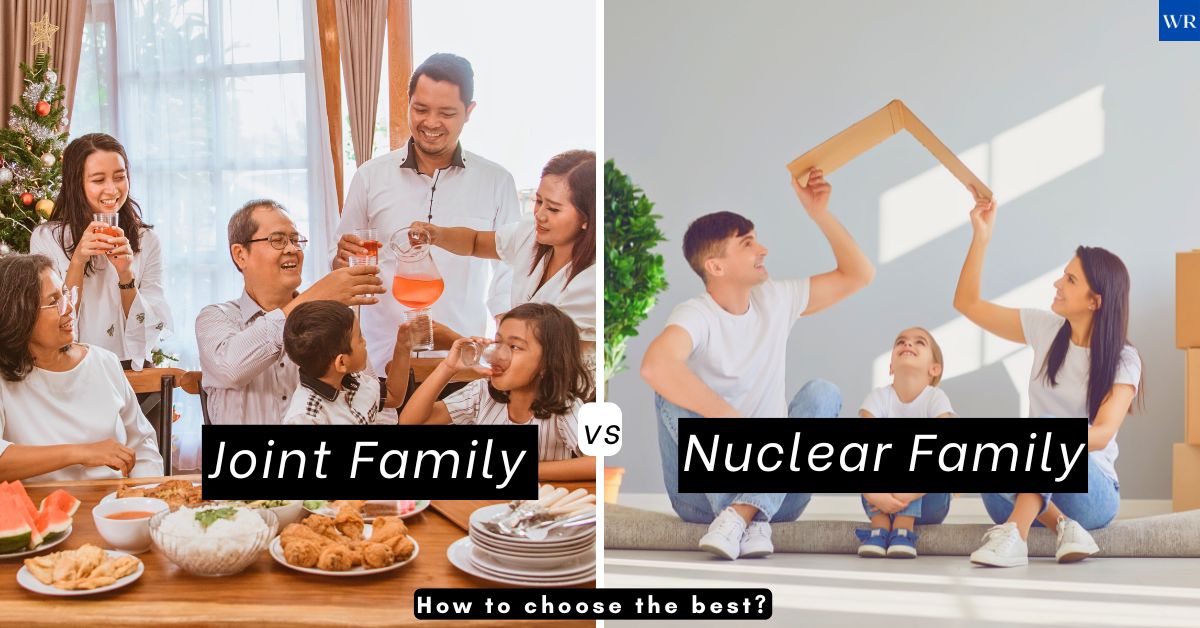
Family has been our support system. Choosing between joint family vs nuclear family is very personal and often debated. As per a recent article by the Hindu Businessline, almost 50% Indian households are nuclear (2022), which was 37% in 2008.
Our society is constantly evolving, and so are our living arrangements and family dynamics. Both joint and nuclear family structure has unique opportunities and challenges for raising children. But how do we choose between them? Let us explore both one by one.
Table of Contents
Joint Family vs Nuclear Family: Get To Know Them
Joint Family
Traditionally, a joint family was where multiple generations lived together. This included grandparents and their children. Sometimes, even second cousins lived together. Joint families back then had a concept of one head of the family (usually the eldest member) and a single kitchen.
Also Read: How to care for elderly at home
However, today the concept of the joint family has been redefined. Today, living in a joint family can be called living with one’s parents. But we can still find families following the traditional way of living together.
This change has not happened overnight. With the rise of urbanisation and globalisation, people started shifting to cities in search of work, leaving behind their ancestral homes.

Advantage and Disadvantage of Joint Family
Growing up in a joint family has both advantage and disadvantage.
Advantages of a Joint family
- Support System & Childcare: Less childcare burden for working parents.
- Beneficiaries: Kids, parents, grandparents.
- Emotional well-being: Shared responsibilities, diverse perspectives.
- Beneficiaries: Parents, grandparents.
- Culture & values: Exposure to traditions, respect for elders, empathy, sharing, and conflict resolution skills.
- Beneficiaries: Kids
- Social skills development: Constant interaction enhances communication skills.
- Beneficiaries: Kids
- Financial security: Shared expenses.
- Beneficiaries: Grandparents, Parents
- Care: Better provided when living together.
- Beneficiaries: Grandparents, Parents, Kids.
Disadvantages of a Joint Family
- Privacy: Limited individual space for marital intimacy.
- Affected: Married couples
- Parenting decisions: Generational gaps can lead to differences in opinion.
- Affected: Parents, kids, grandparents.
- Kids’ Discipline: If overridden, can lead to conflict & resentment
- Affected: Parents, grandparents, kids.
- Overprotection: Can lead to resilience & hinder problem-solving skills.
- Affected: Kids
Nuclear Family
Most of us today live in a nuclear family where kids mostly live with their parents. This structure has become increasingly common in urban areas.

Advantages & Disadvantages of Nuclear Family
Today our socio-economic structure has become such that very few of us get to live with our elders. There are several factors for this, like employment, privacy, and even detachment from one’s family.
Advantages of a Nuclear Family
- Autonomy & Control: Parents have full control to implement their parenting style.
- Beneficiaries: Parents
- Privacy & Individuality: More time for self and partner.
- Beneficiaries: Parents
- Flexibility & Mobility: Easier to relocate for career opportunities, educational pursuits, or personal preferences.
- Beneficiaries: Parents
- Decision making: Less opinion makes it easier.
- Beneficiaries: Kids, Parents
Disadvantages of a Nuclear Family
- Support system: Limited as parents bear sole responsibility for childcare and household tasks.
- Affected: Parents
- Social & Emotional: Can feel isolated.
- Affected: Parents, kids
- Financial Burden: Higher, as the entire financial burden rests on one or two earning members.
- Affected: Parents
- Intergenerational Wisdom: May miss out on daily wisdom, traditional practices, and life experiences shared by elders.
- Affected: Kids, Parents
- Limited Scope of work opportunities: Since it is difficult to leave kids alone.
- Affected: Mostly mothers
- Emergency preparedness: Handle the situation alone
- Affected: Parents
Joint Family vs Nuclear Family Which Is Better?
The decision to choose between joint family and nuclear family is very personal. This is because the situation for every family is different. You need to evaluate your priorities and set boundaries. Finding a reliable house help can be of great help!
I live in a nuclear family, but would like to be in a joint family structure. Although I’m very happily settled, there have been situations when I wished my family were closer. So many problems would have been easily solved! Here are a few instances when I craved a joint family structure:
- Pregnancy: We were alone, and I missed the comfort of an elderly person taking care of me. Although my husband did his best.
- Postpartum Recovery: I found it very difficult to navigate between work, household chores, a newborn’s responsibilities and self-care.
- During Illness: Whenever any of us fell ill, it used to be a tough time to manage. There was stress, financial strain and a feeling of being completely consumed by caregiving.
- Missing out on professional opportunities: I deal with it even today, when my little one is 4 years old. Yes, I say no to work outside my comfort zone, more precisely, outstation.
- Isolation: Living away from the family, I experienced loneliness and a lack of immediate support. I wished someone would tap me, saying, “I’m here for you.”
- Marital strain: It took me time to settle down and understand that only the two of us can find solutions to our problems.
What to Let Go Of for Harmony
Living in a Joint Family
| Aspect | Remedies |
|---|---|
| Unsolicited Advice & Opinions (your choices) | Discuss and be on the same page with your partner. Educate on outdated advice. Do not always debate. |
| Minor Lapses in Personal Privacy (entering without permission/overhearing conversations) | Set boundaries. Discuss personal things in private. |
| Subtle Judgments or Comparisons (comparisons of parenting style, lifestyle choices) | Do not get affected by every advice & opinion. Limit information sharing. |
| Imbalances in Chores or Resources (others not equally contributing) | Discuss this gently. Do your part. Acknowledge that everything can not be equally divided. |
Living in a Nuclear Family
| Aspect | Remedies |
|---|---|
| Perfectly Self-Sufficient (I can handle everything my myself) | Have an external support system. Delegate responsibilities with your spouse. Say no to non-essential commitments. |
| Loneliness (The absence of family get-togethers. ) | Join local parenting groups. Connect with family through video calls. Celebrate special occasions. |
| The Lack of Immediate Backup for Crises (Acknowledge that family might not be available for immediate help.) | Make a list of locally available trusted people. Reciprocate when they need. Find a reliable house help. Ensure spouses are equally capable of handling a crisis. |
| Unsolicited questions and advice (from extended family members) | Try to ignore. |
How To Make The Right Choice For Your Family
There’s no one-size-fits-all answer. The ideal family structure depends on various factors. Ask yourself the following questions:
- Your Values and Parenting Philosophy: Do you prioritise collective living and traditional values, or individual autonomy and modern approaches?
- Socio-Economic Factors: What’s your stake in financial stability, career demands, and access to external support systems?
- Family Dynamics: The quality of relationships among family members. A harmonious family is far better than a conflicted one.
- Geographic Location: Analyse where you want to settle down.
Conclusion
Whether you choose a joint family vs nuclear family setup, the ultimate goal remains the same: to create a nurturing, stable, and loving environment for your child to thrive. Both structures offer unique benefits and challenges. The key lies in understanding your family’s needs, establishing clear communication and setting healthy boundaries.
What family structure do you live in? What has your experience been? Do you prefer a joint family or a nuclear family setup for parenting? Share your thoughts and insights in the comments below!
FAQs
-
How can we manage conflicting advice in a joint family setup?
It’s natural for elders to give their advice in a joint family. However, before making a decision, we can discuss it in private. This way, everyone in the family can be on the same page.
-
Which family structure is better for a child’s development?
Both joint and nuclear family structures offer unique benefits and challenges for a child’s development. Joint families can offer more social exposure and cultural learning, while nuclear families might provide more focused parental attention and privacy. The quality of relationships within the family, regardless of structure, is most important.
-
How can we ensure privacy in a joint family?
Discuss this with your family. Make rules like knocking on the door before entering. It’s fine to go for a walk or dinner with your partner. You can gently give verbal and non-verbal cues to ensure privacy.
-
How can we stay connected to our family when living in a nuclear family setup?
Stay connected through video/phone calls. Make family visits whenever you get time. Taking care of small yet important things like bills, medication, and health will ensure a strong family bond.



Leave a Reply