
Table of Contents
“How did you train her for potty? My child is 4 and still struggles with this.”
Vanshika (my daughter) was not even one year old when one of our family members observed her asking me to take her to the washroom. Although all credit goes to my mom, without any doubt, I am going to be the showstopper here!
It takes 3 weeks to break a habit, 6 weeks to develop a new habit and 36 weeks to hardwire this new habit.
Patrick Holford
Struggling with Potty Training Challenges? I am glad to be your guide.
Yes, it has been proven long ago that with proper training and assistance, children overcome the struggles of untimely discharge and are away from the risks of UTIs also. Inculcating the habit of timely discharge of excreta and giving cues when one wants to can be instilled in kids as early as 4-5 months. I have tried this with Vanshika and surprisingly she adopted it very soon. By her first birthday, we were successful in eliminating diapers from our monthly products buying checklist.
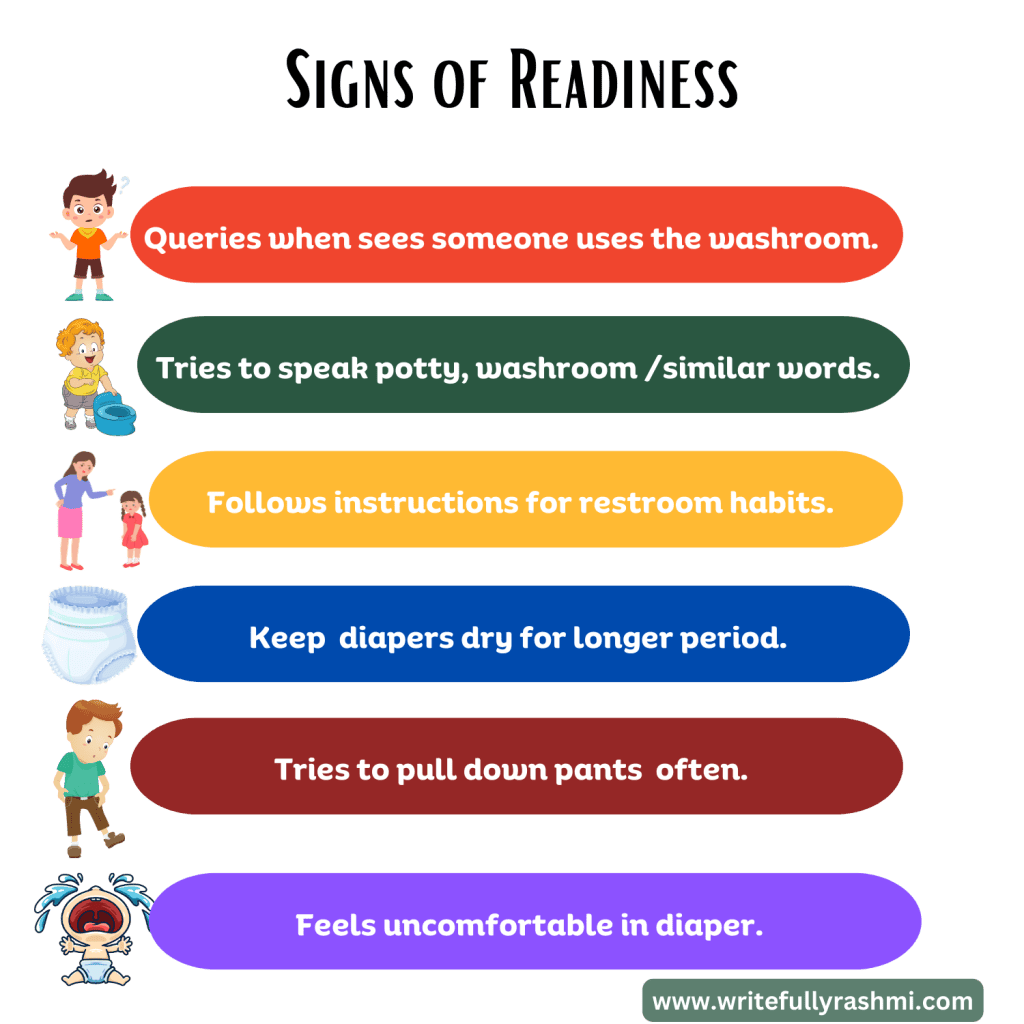
Signs of Readiness
How can parents tell if their baby is ready for potty training?
Parents need to pick up a few cues that can be a signal for potty training. Keeping aside your efforts, children often provide hints from their end. If you observe a change in your child’s behaviour like being uncomfortable with diapers for a long time, little/no discharge in the diaper, expressing discomfort with soiled diapers, showing interest in the bathroom and imitating others’ bathroom routines. It is time to upgrade your child to potty training.
What physical and behavioural signs should parents look for?
Choosing the Right Potty-Training Method
What are the different potty-training methods that parents can try?
Although there are suggested methods for potty training, parents must acknowledge that every child is different. You should not put too much pressure on your child just because his peers are capable of and have successfully succeeded in adopting these methods. On the other hand, Vanshika adopted them way before the said age bracket.
- Child-Oriented Method– It was an initiative of paediatrician T. Berry Brazelton in 1962. This method requires time and patience from parents. At around 18 months, children can be introduced to potty chairs/seats. They can be asked to come along with the parents to the toilet (while they are using it) and just sit on their potty seats. After a week or two, if the child shows some interest in imitating his parents, their excreta can be flushed out from the diaper justifying that it is necessary to only eliminate it in the toilet.
- Toilet Training in Less Than One Day Method– introduced by psychologists Nathan Azrin and Richard Foxx. This method can be adopted at around 20 months when a child is aware that they need to eliminate waste from their bodies. They are guided to go to the toilet, lower their bottom wear and sit on the toilet seat. Repeating this process can lead to a child urinating while sitting on the toilet seat. Parents can praise their children for this and encourage them to discharge stools also. Eventually, the child will gain proficiency.
- Parent-Child-led potty-training Method– In this method, diapers are not introduced to the child from the very beginning. At first, when the child is too little to understand the elimination of excreta, parents can trust their intuition or take the child to the loo frequently (say around half an hour). Soon the child starts giving cues that to parents/caregivers. When they grow a bit older, a fixed schedule like before going to bed/ every 2-3 hours can be followed.
How can parents decide which method is best for their baby?
The answer to this question is as per your baby’s adopting method and family dynamics. Some babies might adopt any of these methods early while others may take time. Moreover, there needs to be someone to help them train. Parents/ someone very close like a grandparent or both.
In my case, my mother took the charge. She used to take Vanshika to the toilet (early morning) even before I was awake. Soon, my little one used to cry or give cues if there was any delay. At around 8 months, we introduced a potty seat to her and provided her with training. Within 10 days, she adopted the procedure. This might be a reason for her closeness to my mom. Let me also clarify that diapers were used when we were either out or in case of emergency.
But a drawback to this was her dislike for diapers at all. Vanshika is a happy child, but not with diapers. Whenever we were out, she was cranky/ felt uncomfortable for some reason. I used to struggle a lot. But with patience and support from family finally, we are in a stage where diapers are no longer necessary for her age (Vanshika is 2 now).
To get a clearer idea, here are some Amazon products that might be useful for parents.
1.LuvLap Adaptable 2-in-1 Potty Training Seat
The LuvLap Adaptable 2-in-1 Potty Training Seat is a Certified Product of European Union 71 Standard. It is suitable for kids up to the age of 2. The design of the product is super supportive for easy bowel movement with a higher back seat to support posture. With a 2 in 1 feature, the upper plate is detachable so that it can be used on adult toilet seats also. It is the best fit for kids up to 2 years old. With over great customer reviews, the LuvLap Adaptable2 in 1 Potty Training Seat has a tremendous rating. To know more click on the Buy On Amazon.
2. Superbottoms Unisex Child Cotton Blend Briefs
Superbottoms Unisex Briefs (Pack of 3) is India’s 1st kids’ underwear made of Modal+Cotton blend. It is super stretchable, 2x softer with ultra-breathable fabric. Its tagless feature does not irritate kids. It has been a trusted product among moms with valuable customer reviews and high rating. Superbottoms Unisex Briefs also are budget-friendly, so grab your deal now! To know more, click on Buy On Amazon.
Overcoming Challenges
What are common challenges faced during potty training, and how can parents overcome them?

How should parents handle setbacks and accidents without discouraging their baby?
When setbacks occur, parents should respond with understanding and reassurance. Encourage the child to try again, and celebrate their progress, no matter how small. Remember, potty training is a learning process, and accidents are a natural part of it.
Celebrating Success
How should parents react when their baby has successfully adopted the potty-training process?
Kids get a moral boost whenever someone praises them. Parents can praise them verbally or through gestures. A pat on the back, a high-five, clapping or a special treat can be followed.
When can parents consider their baby fully potty trained and ready to move on?
A successful potty-trained child wets his pants rarely or by accident. He is capable of using the washroom on his own (some help is required by the parents still).
What are some of the things that parents/caregivers should remember while potty training?

How can someone potty train as a working parent?
As a working parent, training your child can be a bit tricky. But parents can also be a part of it and navigate the process from time to time. Below are some suggested methods, although one can personalize them as per schedule.
- Scheduling: Start potty training your child when you have enough time to guide your child. A new process can be tricky for kids, and they may be confused and refuse straight away.
- Communicate: Discuss the process and schedule with your caregiver.
- Weekends special routine: Utilize weekends for reinforcement.
- Talk to your child: Since you won’t be around, ensure your child is comfortable using the washroom in your absence.
- Involve: Make it a fun process. Educate your child to do the entire process solely.
- Manage your schedule: Discuss this with your partner and schedule your working hours accordingly.
- Diet: Take care of the diet also. With a healthy diet, bowel movements can be easygoing.
Conclusion
Baby potty training is a significant milestone that requires patience, understanding, and support from parents and caregivers. By recognizing signs of readiness, choosing the right approach, offering positive reinforcement, and being patient with setbacks, parents can help their children develop essential self-care skills and gain confidence in their abilities. Celebrate each step of progress and remember that every child is unique, requiring an individualized approach to potty training. Embrace this journey with enthusiasm and be prepared to celebrate your baby’s success in mastering this essential life skill.
“Please note that this article contains Amazon affiliate links. If you purchase through these links, I may earn a commission at no additional cost to you.”
Frequently Asked Questions
1. When should I start potty training my child?
Since all kids are different, their adaptability might also differ. But children always provide cues. Parents need to pick those up and proceed as per it.
2. How long does potty training usually take?
The duration of potty training varies for each child. Some children may master the process in a few weeks, while others may take several months. Be patient and flexible, as the timeline can differ for every child.
3. What should I do if my child resists potty training or has accidents?
It’s normal for children to resist or have accidents during potty training. Stay patient and avoid punishment. Offer understanding and positive reinforcement to encourage your child and help them feel confident in their progress.




Leave a Reply