

“Children are the living messages we send to a time we will not see.”
Neil Postman
“Good Morning Students. Today we will discuss Chapter 3, Learning about Good Touch Bad Touch.”
I can still remember how we were introduced to Good Touch Bad Touch in our school. Back then it was just a regular chapter with a basic understanding of our personal boundaries. But now I feel it was one of the most powerful tools that was taught to our class with a futuristic vision.
Teaching kids about good touch bad touch is a crucial aspect of ensuring their safety and well-being. In today’s world, open communication and age-appropriate education are essential to help children understand personal boundaries and recognize inappropriate behaviour.
Table of Contents
What is Good Touch Bad Touch?
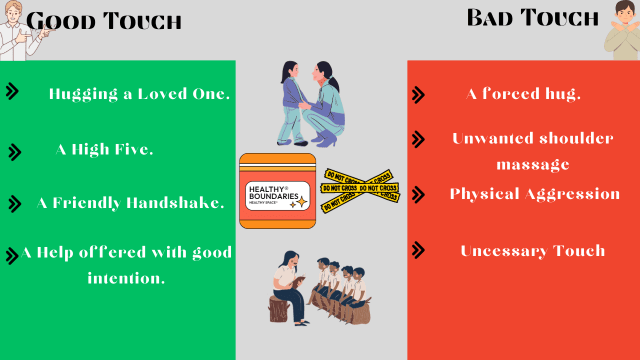
Good touch can be any physical contact that is safe, appropriate and comfortable. It is part of a healthy relationship. Any inappropriate physical contact that is intended to or causes discomfort to the receiver falls under Bad Touch.
Here are a few examples of Good Touch Bad Touch.
| Good Touch | Bad Touch |
| 1. A Friendly Handshake. | 1. Overfriendly Stranger’s Touch. |
| 2. Hugging a Loved One. | 2. Unwanted Shoulder Massage. |
| 3. Holding Hands. | 3. A Forced Hug. |
| 4. Doctor’s Examination. | 4. Physical Aggression. |
Parents might think that their kids are not at the age to understand these concepts or they find it awkward to discuss such sensitive topics with them.
The solution for the first query is age-appropriate introduction. My daughter is 2.5 years old and is around me most of the time. But she will be enrolled to school soon. Also, I cannot accompany her everywhere she goes. I try to teach her good touch bad touch with everyday gestures like a handshake and a pat on her back. I also listen to her broken sentences.
Also Read: Heat Wave Safety Tips for Students: 7 Things to Remember for School Travel
Parents should always listen to the clues that kids provide. It might be possible that they are referring to some unwanted situations. Educating kids about Personal Boundaries is an essential part of parenting. In the movie Ribbon, the father gets to know about the mishandling of his child through his daughter’s gesture in the lift. Had he not paid attention to this, he might not have ever known of the horrific incident.
With grown-up kids, parents might take the help of someone very close to the child to fade out the awkwardness. Explain to them the importance of touch awareness and encourage them to say no to it and raise their voices against it.
Why is it important to discuss Good Touch Bad Touch with Kids?
The World Health Organization in one of its articles has estimated that around 1 billion kids between the ages of 2-7 years have faced violence(sexual, physical and emotional). WHO has also listed a few probable impacts of this violence namely death, brain malfunction, unwanted pregnancies and a continued cycle of violence by being the exploiter for the next generation.
It is crucial to discuss Good Touch Bad Touch with kids for the following reasons:

How to modify the talk about Good Touch Bad Touch with Kids?
Parents can modify the dialogue for such sensitive issues as per the level of understanding of their children. For my 2.5-year-old daughter, explaining the concept of yes/no came first before explaining Good Touch Bad Touch to her. I always ask her “Can Vanshika give Mumma a hug?”. She has imbibed it in her subconscious mind that one needs to ask permission for a hug/a kiss. I can see her feeling uncomfortable if someone just kisses her and hugs her without asking.
For grown-up kids, addressing the topic directly is justified. They are mature and can handle complex situations.
Regardless of their ages, children should feel safe and confident enough to answer without the fear of any judgment.
When to discuss Good Touch Bad Touch with Kids?
Kids tend to learn things in a better way when they are at home, alone and in a free state of mind. Parents can choose bedtime to discuss the concept of Good Touch Bad Touch with them.
It is advised to discuss the topic during bedtime, over a walk or whenever suitable.
How to initiate the conversation of Good Touch Bad Touch with kids?
For Younger Kids
For younger kids question-answer pattern suits them the best. Parents can hover over the topic before educating them in detail. Since they are unaware of any such terms, they might seem clueless at first. Parents should however be patient and should not force educate their kids. Learning can be provided in batches.
Me: Can Mumma get a hug?
Vanshika: Yes.
Me: Do you like it?
Vanshika: Yes Mumma.
Me: Asking someone before hugging is good. It is called a Good Touch.
Me: What will you do if some stranger hugs you?
Vanshika: ????
Me: Say no!! You can also come and tell me about it.
Vanshika: OK Mumma.
Also Read: How to care for elderly at home: For kids
For grown-up kids
As far as grown-up kids are concerned, it is quite easy for them to understand complex concepts and sensitive topics. Therefore having an open and honest conversation can be a better option.
Parents can begin by asking kids about the concept of Good Touch Bad Touch straight. Their opinion about personal boundaries, anything personal that they want to share or the occurrence of any incident. Parents can assure kids that they are with them always and will stand with them no matter what happens.
This might give kids the confidence to raise their voices and speak up when needed. The moral support of their parents can be a ray of light.
Parent: I want to talk to you about Good Touch Bad Touch. Are you comfortable talking about it now?
Child: Okay. Yes.
Parent: Tell me some examples of Good Touch Bad Touch.
Child: { Answers it.}
Child: What should I do to avoid a situation of a Bad Touch?
Parent: If you are alone, just say NO! You must raise your voice against it. Further, just come and tell me and we will fight against it together.
Identifying Safe Zones
Now, when kids are well versed in the topic, parents can also teach them about people who can be trusted.
Kids interact with a variety of people throughout the day. From family members and strangers to friends. It must be noted that not everyone is a foe or friend. As parents, we should train our kids to identify people who are approaching with good intentions and be guarded against those who intend to harm.
Whom to trust?
The registered cases of Child Sexual Abuse in India are alarming. As per an article in Justice For Every Child, approximately 3 kids are raped every hour, 5 sexually abused per hour and the conviction rate is just 34.9%. No doubt, the global figures are matching or even exceeding this data. As per an article published in Unicef, 120 million girls under 20 years of age have had forced sex.
A trustworthy person can be anyone. A stranger, a family member or a friend. Applying the same logic, they all also fall under the “not-trustworthy” category. As mentioned above, the way a person approaches, talks and touches defines his/her motive. Kids should be trained to acknowledge this intention to prevent any unwanted situation and raise alarm.
What are the red flags a child should acknowledge- Good Touch Bad Touch?
Parents can educate kids about the red flags in people (familiar/strangers). Kids should always be encouraged to raise their voices against any such unethical approach.
- Excessive attention: Individuals who approach children with bad intentions may show an unusually high level of attention or interest in a particular child. They may constantly seek opportunities to be alone with the child.
- Isolation: A person with a bad intention would always want a private space with the kid to either move ahead with his motive/ to manipulate the kid to not reveal this secret to anyone.
- Inappropriate Touch: Touching intimate areas, hugging or kissing can fall under this category.
- Gifts: kids are often showered with gifts like chocolates to make an impression that they are special to the concerned person.
Helpful Resources- Some Important Helpline Numbers/Websites
Since the issue of Child Protection is a global one, it needs to be reported as soon as possible. Here is a list of numbers that can be helpful in this regard.
1 India
- National Commission Of Protection Of Child Rights. To register any complaints: http://www.ebaaIndian.nic.in
- Childline India Foundation. Helpline Number: 1098
- Bachpan Bachao Andolan (Save the Childhood Movement) Helpline Number: 1800 102 7222
2 USA
- Childhelp National Child Abuse Hotline. Helpline Number: 800.422.4453
- Bergman Oslund Udo Little.
3 UK
National Society for the Prevention of Cruelty to Children. Helpline: 0808 800 5000
Some Useful Product Recommendations
1 Body Safety Education- Jayneen Sanders
Body Safety Education- Jayneen Sanders is a guide for parents and caretakers to protect kids from any unethical situations like sexual abuse. It is a one-stop guide for kids of all ages. To learn more about this book, click here.
2 FunBlast Hand Puppets for Kids
The Funblast Hand Puppets for Kids can be an amazing tool for parents to discuss Good Touch Bad Touch with children. Kids tend to understand and relate to educational topics more when they are presented in a fun way. So go and grab this hand puppet and narrate a beautiful story to your little one. To learn more about this product, Click here.
“Please note that this article contains Amazon affiliate links. If you purchase through these links, I may earn a commission at no additional cost to you.”
FAQ
-
When should I start discussing good touch and bad touch with my child?
Begin when your child is as young as three or four, gradually building on the conversation as they grow and mature.
-
What if my child is uncomfortable talking about this topic?
Be patient and reassuring. Let your child know that you are there to support and protect them. Use age-appropriate resources like books and games to make the conversation more engaging.
-
What are the signs that my child may have experienced a bad touch?
Look for signs of discomfort, fear, or sudden changes in behaviour. These may include withdrawal, aggression or a sudden aversion to a particular person.
-
What should I do if my child discloses a bad touch experience?
Stay calm and reassure your child that they did the right thing by sharing. Listen attentively, believe them, and report the incident to the appropriate authorities or child protection agencies.



Leave a Reply