

Safeguarding the well-being of our children is the highest priority in today’s world. Teaching kids to recognise the symptoms of unwanted touch is needed to ensure their safety. Children who receive this education are better equipped to defend themselves and ask for assistance when necessary.
“Why is she crying, Mumma?”
This was my niece’s query after watching a TV series dedicated to child sexual abuse. I could see how confused my sister-in-law was about addressing and modifying this query as per her 5-year-old daughter.
As per an article in NCBI by Banvard-Fox, Christine et al (2020), sexual violence in minors accounts for 40-60% of the total rape cases, most of which are only disclosed when the victims reach adulthood. This is how untouched the topic of recognising the signs of unwanted touch is. Parents and caretakers can not only train kids to protect themselves but also prevent any incident of child sexual abuse.
Table of Contents
Understanding the Significance of Addressing Unwanted Touch
As per an article published in The Lancet, the long-term effects of child sexual abuse might take a toll on physical and psychological health. Therefore, we must train kids to not only identify but also stop someone from making an unwanted move. Here are some ways through which parents can smooth the process.
Also Read: Joint Family vs Nuclear Family
Converse Like A Friend
Open and Honest communication can only be successful when parents approach, listen and encourage other kids as friends. Sometimes it is the barrier of the generations that holds a child back from expressing any discomfort to his parents. This is the reason why most of the incidents of unwanted touch are revealed by children only when they grow up.
Having a non-judgemental talk can be a sign of relief for kids to open up and report any such instances. The perpetrators of unwanted touch are more likely to be someone known. As per an article under the Office Of National Statistics, 37% of such abusers are known to the victim while 30% are unknown.
Personal Boundaries: An Essential Aspect
Educating children about personal boundaries should begin at an early age. Parents can educate kids about how important is it to maintain a personal boundary. This will empower kids to be more alert and assertive when needed.
Discussing Consent
Parents can modify teaching content as per the age and level of understanding of their kids. My daughter is a toddler and I began teaching her consent with “no” and “yes”. With a simple question like asking before a hug, her subconscious mind has registered it as a prerequisite.
Kids can be educated to differentiate between a Good Touch and a Bad touch.
Reaffirming Online Safety
Parents can modify the screen time of their kids by measures like Parental Control. This can be achieved by educating kids about the potential dangers of sharing personal information.
Moreover, kids need to be trained that this “LA LA LAND” is just an art, a piece of scripted enactment. It has nothing to do with real life and even the actors are portraying a character. I can see kids adopting bits and pieces of their favourite actors in their lives.
Also Read: How to care for elderly at home: For kids
5 Best Signs for Kids About Unwanted Touch
Now that we have discussed the importance of addressing unwanted touch and how parents can train their kids for it, let us also see some common instances that the perpetrators use to misguide kids and become a victim of child sexual abuse.
Let our kids be safe not only when we are around but also when far away from us.
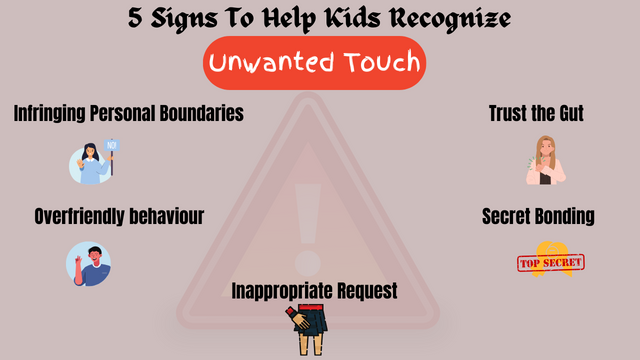
Infringing Personal Boundaries
Young Children are most likely to be victims of child sexual abuse. Since they are innocent and can be easily misguided/frightened in the name of “exposing them”, parents/caregivers must groom kids for any such infringement of personal boundaries.
Children who are educated about their body autonomy are more likely to report instances of unwanted touching. They must be groomed to acknowledge that a medical examination is the only way that their genitals are to be touched/seen.
Trust the Gut
A child might feel awkward in a situation. This might be with a known person/a stranger. Parents can encourage kids to report any chance of unwanted touching. This might slow down the graph of child sexual harassment in the first place.
Overfriendly Behaviour
The perpetrators of child sexual harassment generally show over-friendly behaviour with their “future targets”. This can be by gifting, caring more than required or even an over-possessive attitude. Kids can be educated to watch for this behaviour as a warning sign and report guardians instantly.
Secret Bonding
A big no-no for a child is the secret bonding that anyone asks for. No one in this universe is as concerned about a child as his parents. So parents can have an open conversation with kids to let them know if anyone encourages them to keep secrets.
Inappropriate Requests
Children should be educated to immediately report any inappropriate requests by either a known person/a stranger. Activities like requesting to touch intimate parts, and sharing pictures/videos can be harmful to kids.
Empowering Kids Through Tools
Parents can take the help of age-appropriate educational tools to teach children about consent and personal boundaries. This can be a smarter approach to train kids about unwanted touch.
Here is a list of a few products that can be a catalyst in educating kids on this concern.
Also Read: 5 Excellent Ways CBSE Parenting Calendar Can Transform Parent Teacher Communication!
1 Fire-Boltt Ninja Call Pro Smart Watch
The Fire-Boltt Ninja Call Pro Smart Watch can be a lifesaver for anyone including kids. The features that make this product a standout in its category are:
- Bluetooth Calling: with the speaker and microphone integrated into the watch, kids may place and receive calls directly.
- Voice Assistance: With the smartwatch’s integrated voice assistant, just give commands to it to carry out requests.
- Location: provide details of the location by clicking pictures.
With these superb features, parents can ensure the safety of their kids even if they are away. To learn more about the product, click here.
2 My Little Big Day: A Daily Gratitude Journal for Kids
Kids can express their thoughts, wishes, gratitudes and opinions with the habit of daily journaling. This fun and interactive journal will help your child to express their feelings, process their emotions, and appreciate the simple things in life. It’s also a great way to strengthen the parent-child relationship by making journaling a family ritual. To learn more about his product, click here.
3 Your Body Belongs to You
Your Body Belongs to You by Cornelia Spelman is a children’s book that teaches about body autonomy and consent. It can be a guide for both parents and kids to learn more about unwanted touch. To learn more about the book, click here.
When to Consult a Doctor
When a child experiences emotional difficulties or there are allegations of child abuse, it is crucial to seek professional assistance. Child psychologists and counsellors are essential in giving kids the guidance and support needed to overcome tricky situations.
Conclusion
Giving kids the skills to spot signs of unwanted touch is important in a society where protecting children is everyone’s foremost concern. We can teach our children the skills they need to defend themselves with friendly communication, educating them about personal boundaries and discussing consent, training them to trust their intuition, and assuring their online safety. Giving them access to resources that are appropriate for their age and encouraging them to seek expert assistance when necessary. As responsible parents, we can work together to establish a secure and nurturing atmosphere where our kids can flourish and be well-cared for.
“Please note that this article contains Amazon affiliate links. If you purchase through these links, I may earn a commission at no additional cost to you.”
FAQs
-
Why is it important to teach kids about recognizing signs of unwanted touch?
Teaching kids to recognize signs of unwanted touch is crucial because it empowers them to protect themselves from potential harm and abuse. It also encourages open communication about sensitive topics.
-
How can I help my child feel comfortable discussing uncomfortable experiences?
Create a safe and non-judgmental environment where your child knows they can talk to you about anything. Encourage open dialogue, active listening, and reassurance that you will take their concerns seriously.
-
What are some warning signs that my child may have experienced unwanted touching?Warning signs may include changes in behaviour, regression in age-appropriate behaviours, fear or avoidance of specific individuals, nightmares or sleep disturbances, and unusual knowledge of inappropriate behaviours for their age.


Leave a Reply