

The first five years have so much to do with how the next 80 turn out.
– Bill Gates
Table of Contents
“Mumma, that’s my right hand and this is my left hand.” My 3-year-old daughter said this while looking in the mirror. This made me smile as up until recently, she was confused between right and left.
Parenting is a wonderful journey filled with milestones and discoveries. One of the most exciting aspects is witnessing your child’s brain develop and grow. Did you know that the first six years are crucial for brain development? That’s why stimulating brain development activities at home for 0-6-year-old kids is important. You can do all this at home without investing even a single penny.
Also Read: What is the art of Parenting through yoga?
Let us discuss some fun, easy, and effective activities that you can do with your little one to nurture their cognitive abilities, language skills, and overall brain development.
Brain Development by 6 years
Bill Gates once said, “The first five years have so much to do with how the next eighty turn out.”
By age six, a human brain reaches 95% of its development. Hence, these formative years are very crucial for our children.
Why Brain Development Activities at Home Matter
Early childhood brain development is rapid and profound. A study by Frontiers highlights that a child’s brain can be compared to a plastic that is adaptable to physical and social environments. These formative years lay the foundation for future learning, problem-solving, and social skills. Brain development activities at home for 0-6 years provide a nurturing environment for this growth. They strengthen neural connections, improve cognitive function, and foster a love of learning.
Also Read: Equipping Children for the Digital Era: Screen Smart Kids
Brain Development Activities for Babies (0-12 Months)
Babies below age one are curious to know the world around them. They want to explore things by touch and bite. This is because everything around them seems to be new and exciting. So the next time you see a baby leaning to grab things, let them experience and explore by themselves. (Make sure they are safe). Here are a few brain development activities for infants at home.
Also Read: Best Diapers for Sensitive Skin
Sensory Play
Can you think of some sensory play activities for newborn brain development?
Introduce different textures, sounds, and smells. You can go for stuff like pillows, food, toys or anything around. Be sure that those are clean to avoid any infection to your baby.
Babies enjoy playing with their food; let them explore, and don’t worry about the mess! This will gradually help them develop self-eating habits.
Also Read: Key Components of a Healthy Child Eating Routine

Tummy Time
This strengthens neck and core muscles, which is crucial for motor skill development. Tummy time also helps in digestion. Most of the time babies also start moving around during tummy time.
Tummy Time Activities for Baby Brain Growth
- Classic Tummy Time: Spread a clean sheet on the floor and let your little one do the rest! You can also put pillows nearby to prevent them from getting hurt.
- Tummy Time on Chest: Lie on your back, place your baby on your chest, and tummy down. Your voice and face will keep them engaged.
- Tummy Time on Textured Surfaces: Use textured surfaces like blankets or mats to provide sensory stimulation during tummy time.
Talking and Reading
Engage in baby talk, read simple stories, and sing songs. This helps with language acquisition. Those cute little words like aah, aarh, aaao is more than just cooing, it is the foremost step of communication.
Science Daily in one of its articles confirms how babbling in babies enhances the functioning of their brain. It also suggests that babies respond more to their mothers’. So mommies it’s time for you to talk to your little ones. Read them a story every day and see how quickly you get their responses.
Object Permanence
Play peek-a-boo or hide toys under a cloth. This helps babies understand that objects exist even when they can’t see them.
Brain Development Activities for Toddlers (1-3 Years)
Nurturing toddlers with interactive play and sensory experiences is crucial for optimal brain development during childhood. Toddlers also tend to get attracted to digital screens as their capability to handle these products has improved.
Also Read: The Playful Path to Development: Nurturing Skills and Abilities in Toddlers
Building Blocks
Encourage creativity and problem-solving with building blocks or stacking cups. You can also use household items of varying sizes and shapes, and ask your toddler to sort them.

Imaginative Play
Provide opportunities for pretend play with dolls, toy cars, or kitchen sets. This fosters creativity and social skills. Imaginative play enhances kids’ ability to reason in a hypothetical environment.
My daughter has a doll. She has named her Dolly. She has pretty much the same routine that I follow for my daughter. I see her talking similarly to Dolly as I converse with her.
Also Read: Struggling with Potty Training Challenges?
Simple Puzzles
Introduce age-appropriate puzzles to enhance problem-solving abilities.

You can also take stuff of different sizes and shapes from your home and ask your toddler to pick it up. Kids love these kinds of games where we adults get involved. They will even respond by asking a few questions to you too!
Also Read: Is 1.5 the Right Age for Play School?
Language Games
Play rhyming games, and sing songs along with your baby.
This is the best time for kids to learn more about their mother tongue. Converse with them in your local language. It is fine if they don’t understand it at first, but eventually, they will.
My daughter can talk and play with me for hours without asking for any digital product. Sometimes it becomes a bit overwhelming for me, but ultimately I also get a break from the hustle and bustle.
Also Read: Want to Promote Mother Tongue in Your Child?
Brain Development Activities for Preschoolers (3-5 Years)
Arts and Crafts
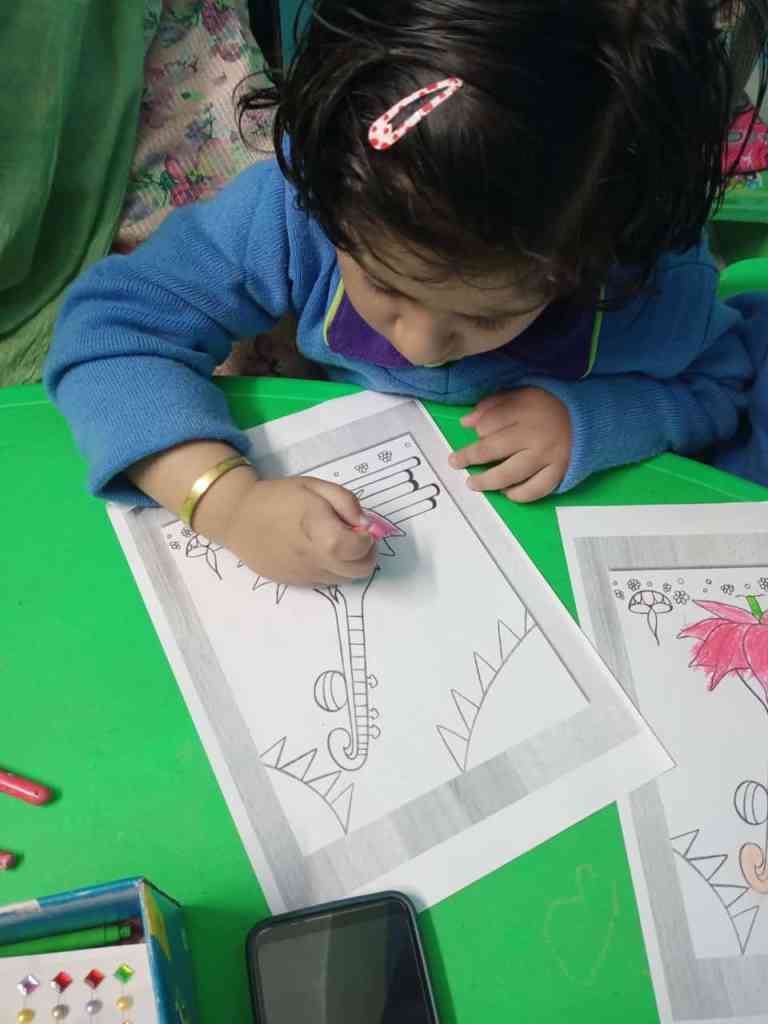
Engage in painting, drawing, colouring, and other art activities. This enhances creativity and fine motor skills.
Vanshika loves to paint. You can spot her love for arts and crafts in every corner of our house. Whenever we go out, she urges us to buy a pencil, colours or a colouring book. I have noticed that her drawing skills have improved. I find it the best alternative to those unhealthy chips or chocolates that she might have consumed otherwise. Yes, there are days when she asks for ice cream or a pastry too!
Storytelling
Encourage your child to tell stories, either by making them up or retelling familiar ones.
Do you remember how our parents/grandparents used to entertain us when we were children? Don’t you miss those days?
That is the power of storytelling.
All you need is a good plot, some relatable characters and a few magical words (zoom, dhisum, dharam) to keep our audience engaged!
“Uske baad kya hua mumma! (What happened after that)” Oh! Those cute sparkling eyes make me go on!
Number and Letter Recognition
Introduce numbers and letters through games and activities. Every child is different and will take his time to recognise numbers and letters. However, we as parents can do our bit by introducing them to these occasionally. Activities like flashcards, puzzles, and worksheets can be helpful. Introduce one/two new letters each day. Also, correlate these letters and numbers with their surroundings.
Don’t worry if kids sometimes scribble on walls; let them explore.
Also Read: Why do Toddlers Write on Walls?
Outdoor Play At Home
Encourage running, jumping, climbing, and other outdoor activities to develop gross motor skills.
You can do this in your backyard, balcony or any other home-dedicated play corner.
You can play games like:
- Follow Your Leader: Lead your child through various movements like hopping, skipping, and crawling.
- Chase and Pop Bubbles: Promotes gross motor skills and hand-eye coordination.
- Obstacle Race: Use cushions, blankets, laundry baskets, and sturdy chairs to create a mini obstacle course.
- Ball Play: Use a laundry basket as a target for throwing balls.
- Hide and Seek: Take turns to play this.
A study by Pubmed Central states how young children can understand the world around them (without any adult intervention) with access to outdoor play. But there are days when it is advisable to be indoors. Extreme weather conditions, air quality issues, infection outbreaks, unsafe environmental conditions, recent injury/illness and local safety concerns are all valid reasons to prioritize indoor activities and ensure your child’s well-being.
Also Read: 7 Empowering Ways Outdoor Play Can Boost Children’s Learning Potential.
Brain Development Activities for Early Elementary (5-6 Years)
Board Games
Introduce simple board games that require strategy and problem-solving.
Board games like chess, puzzles, and ludo can help them analyse their moves before they play their turn. This can help them with planning and execution, which in turn will enhance brain development.
Also Read: Sibling Wars No More: The Parent’s Guide
Science Experiments
Conduct simple science experiments at home to spark curiosity and critical thinking.
Here’s one for you.
The Magic Milk Experiment

Reading and Writing
Encourage reading and writing through fun activities like creating stories or writing letters.
You can conduct a storytelling competition at home! Give them a moral and ask them to build a plot around it.
Tips for Maximizing Brain Development at Home
- Create a stimulating environment: Provide a space where your child can explore and play freely.
- Be consistent: Engage in these activities regularly for optimal results.
- Make it fun: Learning should be enjoyable!
- Be patient: Every child develops at their own pace.
- Limit screen time: Excessive screen time can hinder brain development.
Conclusion
Nurturing your child’s brain development is one of the most important things you can do as a parent. Incorporating these fun and engaging brain development activities at home for 0-6 years can lay a strong foundation for their future success. Remember, every interaction is an opportunity for learning and growth. Which of these activities are you most excited to try with your child? Share your thoughts and experiences in the comments below! Also, don’t forget to share this article with other parents who might find it helpful.
FAQ
-
How much time should I spend doing brain development activities with my child each day?
Even short and regular interactions can be beneficial. The key is consistency and quality time.
-
What if my child isn’t interested in a particular activity?
Don’t force it! Try a different activity or revisit it later. The goal is to make learning fun and engaging.



Leave a Reply