

” It’s nice to see that your child is picking up cues from three languages (Maithili, English & Hindi). Good to know that you are promoting your mother tongue.”
Those were the words of one of our neighbours when she saw Vanshika conversing with us. Let me give a brief into this. Me and my husband were consistent that Vanshika is going to learn Maithili and it continued being the language spoken at home. We were worried (and still are) about the “not so cool” tag that exists in society if a kid converses in any other language rather than English/Hindi (the former being the primary choice).
Now to put facts in place, UNESCO in one of its articles has highlighted the importance of linguistic diversity and stated,” When a language disappears, it takes with it an entire cultural and intellectual heritage.” Furthermore, UNESCO has also stressed incorporating the mother tongue into the education system.
Table of Contents
The Significance of Mother Tongue
“If you talk to a man in a language he understands, that goes to his head. If you talk to him in his language, that goes to his heart.”
NELSON MANDELA

Language is an integral part of our identity and culture, and it plays a crucial role in our cognitive development. Fluency in the mother tongue ensures a child’s connection to his culture, enables cognitive development and even acts as a catalyst for learning other languages. Mother tongue also installs an understanding of the surroundings and culture in an individual.
How can you create a language-rich environment at home?
Parents when choosing their mother tongue as the language at home, imbibe a sense of inclusiveness to adopt it within their children too. This makes children accustomed to vocabulary from an early age.
Establishing meaningful conversations with your child in your mother tongue can be an effective way to help your child adopt the native language.
Reading books and storytelling in the mother tongue is an excellent way to captivate a child’s interest in the language. Parents can buy storytelling books in their regional language and read them aloud. They can also translate the books into their regional language while reciting them to kids. This will not only expand their vocabulary but also make language learning an enjoyable and immersive experience for the child.
Here are a few recommendations.
108 Panchatantra Stories (Kindle Edition)
The 108 Panchatantra stories are available in both Kindle and Paperback editions. Written by Vishnu Sharma and edited by Maple Press, is a 108 set of stories that can be read by people of any age group. Immerse yourself in the enchanting tales of friendship, bravery, wit, and compassion, as each fable unveils a treasure trove of timeless wisdom. Explore the depths of human nature and learn valuable life lessons that will stay etched in your heart forever. Being one of the best sellers, it can be a great way to connect with your child by reading and narrating to them in your mother tongue. I recommend Panchatantra stories from my own experience. For more details, (story and images) you can check by clicking here.
PlayShifu Educational Word Game
The Playshifu Educational Word game is a fantastic way to upskill your child’s Linguistic, Reading, Comprehensive, Cognitive and Motor skills. The age bracket is 4-10 and I assure you I will buy one for my daughter when she is 4. It comprises a letter trunk consisting of 48 letter tiles, a manual, a gamepad, and a Plug app which is compatible with tabs and smartphones (Check details). Parents!! you can help your child learn by themselves or instruct them (in your mother tongue) for better understanding. To know more about the feedback and details of the product, check by click here.
My First All-in-One (Hindi-English)
With My First All in One Picture book (available on Kindle & Paperback), you can introduce kids to the Alphabet, Numbers, Birds and Animals at an early age. Pictorial cues are the most relevant and relatable for preschoolers. Sit along with your child and make learning easy by conversing in your mother tongue. I recommend this product after buying it for my little one. She is 2 and can say one word for every letter (recognizes the word by picture also). This is your go-to product. To know more, click here.
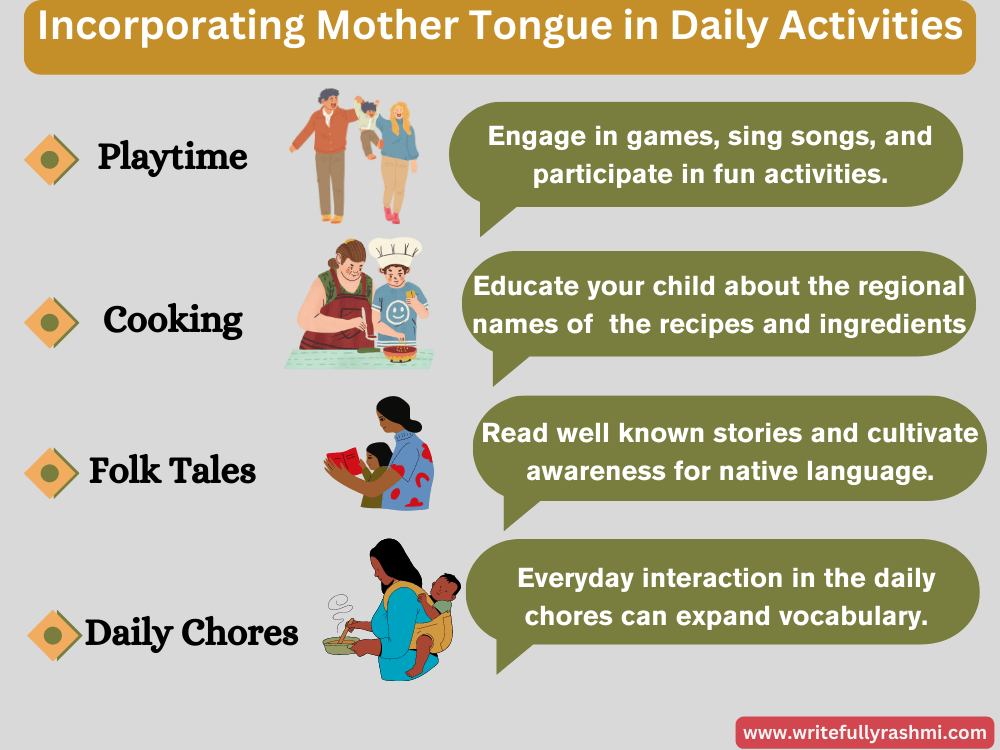
How to incorporate the use of native language in daily activities?
Also Read: 5 Excellent Ways CBSE Parenting Calendar Can Transform Parent Teacher Communication
How can family and community help in embracing the mother tongue in kids?
- Language Use at Home: Regular usage of native language can be a modifier for kids in embracing their mother tongue.
- Interacting with Extended Family: When kids analyze that a language, they speak at home is also spoken within their extended family, they cultivate a sense of closeness to it. Family gatherings and celebrations can become opportunities to use the mother tongue and strengthen cultural connections.
- Community Events and Celebrations: Be involved in any such gatherings where the mother tongue is promoted. Children can also discover friends here and establish stronger bonds of friendship through a common regional language.
- In-school events: Organize in-school events where local language is encouraged. Kids can find this encouraging.
Also Read: How to care for elderly at home: For kids
What is the significance of celebrating Language Diversity?
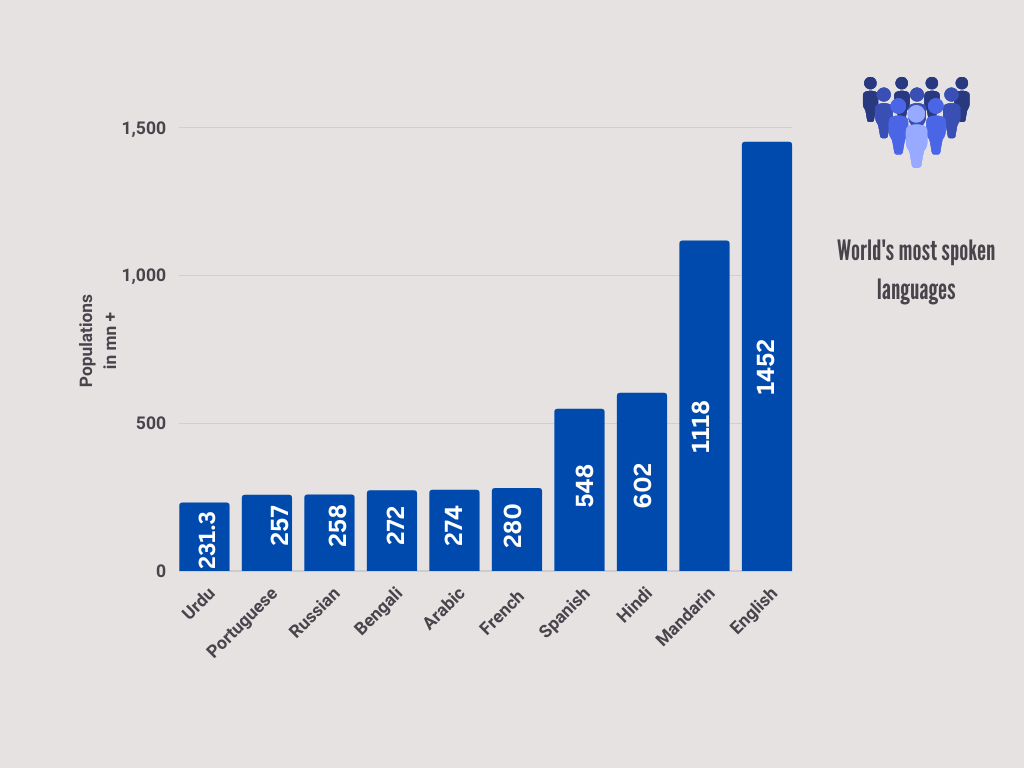
The above graph shows the Top Ten spoken languages in the world. Within these languages also, there are various sub-languages spoken. We can do our bit by promoting our regional languages. Embracing multilingualism and exploring them can be a way to upgrade interest in these languages among kids.
Why is it important to teach children in their mother tongue?
- Cultural Identity: The Mother tongue acts like a bridge between a person and his heritage and cultural roots. It instils a sense of pride in their linguistic heritage.
- Language Development: It serves as a base for learning and adopting other languages also.
- Cognitive Development: Research has proved that by adapting to the mother tongue, kids can enhance cognitive development like memory retention and problem-solving.
- Language preservation: The essence of a language lies in its widespread. The more a language is spoken the more are the chances of it being passed to the next generation.
- Global Identity: Being proficient in one’s mother tongue can instil a sense of Global Citizenship. Unity in diversity might be the perfect fit for explaining multilingualism.
How do I teach my mother tongue to my kids in a foreign land?
Since most of us have migrated to a foreign land for various reasons, it is sometimes tricky to accustom kids to their regional language. Parents can adopt the following strategies.
- Communication: Whether you live in a foreign land or not, until you converse in your mother tongue, your child will not be able to learn it on his own.
- Watch Movies and Shows: Enjoy your family time by watching movies and shows in your regional language. This will create a sense of oneness within kids and they will look forward to exploring the language even more.
- Connect with Extended Family: Maintain contact via video calls or regular visits.
- Cultural Immersion: Celebrate cultural festivals, cook traditional dishes, and participate in cultural events.
- Visit Home Country: Plan visits your home country to immerse your kids in the language and culture. Experiencing the language in its natural setting can be a valuable learning experience.
Can someone have more than one mother tongue?
Yes, one can have more than one mother tongue. Kids with Bilingual parents can explore both languages and be equally proficient.
Children of immigrant families have the opportunity to be exposed to and learn the language of their parent’s home country as well as the language(s) of the country they reside in.
In countries with multi-regional languages, kids are exposed to and proficient in more than one language from birth.
Will you teach your children your mother tongue?
Yes, as explained earlier, I am teaching my daughter Maithili along with other languages. I do not want her to regret later in life for not learning her mother tongue. This will help her to be familiar cultural heritage, develop language proficiency, and foster a sense of identity and belonging.
Conclusion
Promoting the mother tongue in children is not just about language acquisition; it is about preserving cultural heritage and nurturing a strong sense of identity. By creating a language-rich environment at home, engaging in meaningful activities, and embracing language diversity, parents can empower their children to embrace and cherish their mother tongue. The journey of learning and growing with the mother tongue is a gift that lasts a lifetime and opens doors to a world of language and cultural richness.
“Please note that this article contains Amazon affiliate links. If you make a purchase through these links, I may earn a commission at no additional cost to you.”
Frequently Asked Questions
At what age should I start promoting the mother tongue to my child?
It’s best to start promoting the mother tongue from an early age, as young children are more receptive to language learning.
What if my child attends a school where the mother tongue is not taught?
If the mother tongue is not taught at your child’s school, you can supplement their learning at home, through language classes, or online resources.
Can promoting the mother tongue hinder my child’s proficiency in other languages?
No, promoting the mother tongue does not hinder proficiency in the dominant language. On the contrary, being bilingual can enhance language skills in both languages.



Leave a Reply